
Bring Power back to your Drive
Engine Compatibility Checker
Replacing or upgrading an engine is not something you do every day. It’s a major investment that affects your vehicle’s performance, reliability, and long-term value. One small mismatch in engine type, mounting position, or electronic configuration can lead to serious mechanical and financial problems. That’s why our Engine Compatibility Checker at Ultimate Auto Care is designed to give you confidence before you buy.
Choosing the wrong engine can result in unnecessary labor costs, return shipping fees, programming complications, or even complete installation failure. Our compatibility tool helps reduce those risks by verifying that the engine you select properly matches your vehicle’s specifications.
Why Engine Compatibility Is So Important
Modern vehicles are far more complex than older models. Years ago, swapping an engine was mostly about matching displacement and basic mounting points. Today, engines are integrated with advanced electronics, onboard computers, emission systems, and transmission controls.
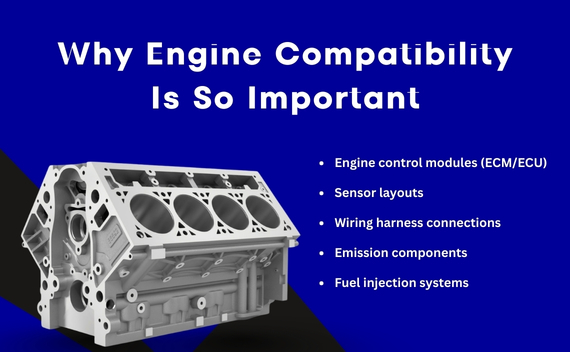
Even two engines that look similar externally may have different:
- Engine control modules (ECM/ECU)
- Sensor layouts
- Wiring harness connections
- Emission components
- Fuel injection systems
If any of these elements do not align with your vehicle’s configuration, the result can be frustrating and expensive.
A proper compatibility check ensures that the replacement engine fits both mechanically and electronically.
What Our Engine Compatibility Checker Reviews
Our system evaluates multiple critical factors to confirm correct fitment and performance alignment.
1. Engine Code Match
Every engine has a unique engine code assigned by the manufacturer. This code identifies internal specifications such as compression ratio, fuel system design, horsepower rating, and emission calibration.
Matching the correct engine code ensures you receive the same configuration your vehicle was originally built with.
2. Mounting Alignment
Engine mounts are designed for specific chassis structures. Differences in bolt patterns or mount placement can make installation difficult or impossible without modification.
Our system verifies:
- Mounting point location
- Engine bracket compatibility
- Crossmember alignment
This prevents unnecessary fabrication or installation delays.
3. ECU / ECM Compatibility
Modern engines rely on computer communication. The Engine Control Unit (ECU) manages ignition timing, fuel delivery, and emission functions.
If the replacement engine does not communicate properly with your existing ECU:
- The vehicle may not start
- Warning lights may stay on
- Performance may be limited
Compatibility verification helps avoid reprogramming surprises.
4. Sensor Configuration
Today’s engines use multiple sensors, including:
- Oxygen sensors
- Camshaft position sensors
- Crankshaft sensors
- Knock sensors
- Mass airflow sensors
Incorrect sensor placement or type can cause drivability issues and fault codes. Our compatibility check ensures sensor layout consistency.
5. Emission Standard Compliance
Emission systems vary depending on state regulations and production year. Vehicles registered in certain states may require specific emission configurations.
A mismatched engine can fail inspection tests or trigger emission-related trouble codes. Our system cross-references emission standards to reduce that risk.
How the Engine Compatibility Checker Works
Using the tool is simple and straightforward. You enter the following vehicle information:
- Vehicle Make
- Model
- Year
- Engine Size
- VIN (optional but strongly recommended)
Once submitted, the system compares your information against manufacturer data and verified engine specifications. It identifies compatible options and flags potential mismatches before purchase.
Providing your VIN allows for the most accurate result because it contains detailed build information specific to your vehicle.
Why VIN Is Highly Recommended
Your Vehicle Identification Number (VIN) is a 17-character code that includes:
- Manufacturing plant
- Engine type
- Transmission configuration
- Trim level
- Production sequence
Two vehicles of the same year and model can have different engines depending on production batch or trim package. The VIN helps eliminate guesswork.
Problems Caused by Incorrect Engine Selection
Installing the wrong engine can lead to multiple complications.
- Check Engine Light Activation: Mismatched sensors or ECU calibration may immediately trigger diagnostic trouble codes.
- ECU Communication Errors: If the engine’s electronics differ from your vehicle’s system, communication errors can prevent proper operation.
- Poor Fuel Efficiency: Incorrect engine calibration may result in higher fuel consumption and reduced performance.
- Transmission Compatibility Issues: Some engines are paired with specific transmissions. A mismatch may cause shifting problems or mechanical strain.
- Warranty Concerns: Installing a non-compatible engine may void coverage or create claim complications.
Avoiding these issues begins with proper compatibility verification.
Best Practices Before Ordering
Even with a compatibility checker, following best practices ensures smooth installation.
- Always Provide Your VIN: The VIN offers the highest level of verification accuracy.
- Confirm the Engine Code: Physically check your existing engine code when possible.
- Verify Transmission Type: Confirm whether your vehicle has automatic or manual transmission. Some engines are configured specifically for one type.
- Confirm Drivetrain Configuration: Check whether your vehicle is 2WD, AWD, or 4WD. Engine accessories and mounting can vary.
- Consult a Professional Installer: A certified mechanic can double-check compatibility details before final purchase.
Benefits of Using Our Engine Compatibility Checker
Our system is built to reduce uncertainty and protect your investment.
You gain:
- Greater confidence in your purchase
- Reduced risk of return or exchange
- Smoother installation process
- Better long-term performance reliability
- Protection against costly mistakes
The goal is not just selling an engine – it’s ensuring the engine works correctly in your vehicle.
When Compatibility Checks Matter Most
Compatibility checks are especially critical if:
- You are replacing an engine after major failure
- You are buying a used or remanufactured engine
- Your vehicle has multiple engine options for the same model year
- You are ordering online without physically inspecting the engine
In these situations, careful verification can prevent significant setbacks.
Additional Considerations
Certain models may have mid-year production changes. That means engines produced early in the year may differ slightly from later versions.
Turbocharged variants, hybrid-assisted systems, or special performance trims may also require specific configurations.
Our compatibility checker accounts for these variations to the extent possible based on provided information.
Final Thoughts
An engine replacement should restore your vehicle’s performance – not create new problems. Taking a few extra minutes to confirm compatibility can save you weeks of frustration and thousands of dollars in unexpected expenses.
The Engine Compatibility Checker at Ultimate Auto Care is designed to provide clarity, reduce risk, and help you make an informed decision. By verifying engine code, mounting alignment, electronic compatibility, and emission compliance, you move forward with confidence.
Before placing your order, use the compatibility tool and provide accurate vehicle details. It’s the simplest step you can take to protect your investment and ensure your vehicle runs the way it was designed to.
If you are unsure about any detail, our support team is always ready to assist you in confirming the correct engine match for your vehicle.